Visit our newsroom to see some of our latest work
Learn more


Australian Federal Budget – Analysis and voter research
Key findings
- Voters are underwhelmed by the Budget, because it does not speak to their immediate priorities. The Albanese Government has a significant task in convincing the public of its merits.
- Capital gains and negative gearing changes are hard to understand and met with scepticism.
- Resilience measures are seen more as a crisis response rather than what voters really want, which is a powerful and credible narrative around sustainable self-sufficiency.
- With ALP primary support slipping, this first Budget of the Government’s second term is an attempt to shore up a voter base. Early indications are that it may not deliver on this objective.
Reasonable doubt
One of the telling responses from voters in focus groups on the Budget was bewilderment at the celebration on the Government benches when Treasurer Jim Chalmers finished his speech. “Am I missing something? Why the applause?”, asked one voter. “I don’t see anything promising at all.”
Voters CT Group spoke with last night were not hostile to the Budget, but neither were they energised or, for that matter, much engaged. The immediate political challenge for the Albanese Government is that the Budget does almost nothing to address the crushing weight of cost-of-living pressures that have dominated voter priorities for years. For most, the answer to the acid test question – “Am I better off?” – is No. So, the Government has a significant job ahead of it to convince voters of the Budget’s merits.
A running theme in our snapshot of initial reaction is, both on the big picture and in the detail, voters doubt this Budget will change much. Any such assessments would be reinforced by a look at the fiscal profile, which shows changes in the headline outcomes for the remainder of the decade are almost imperceptible.
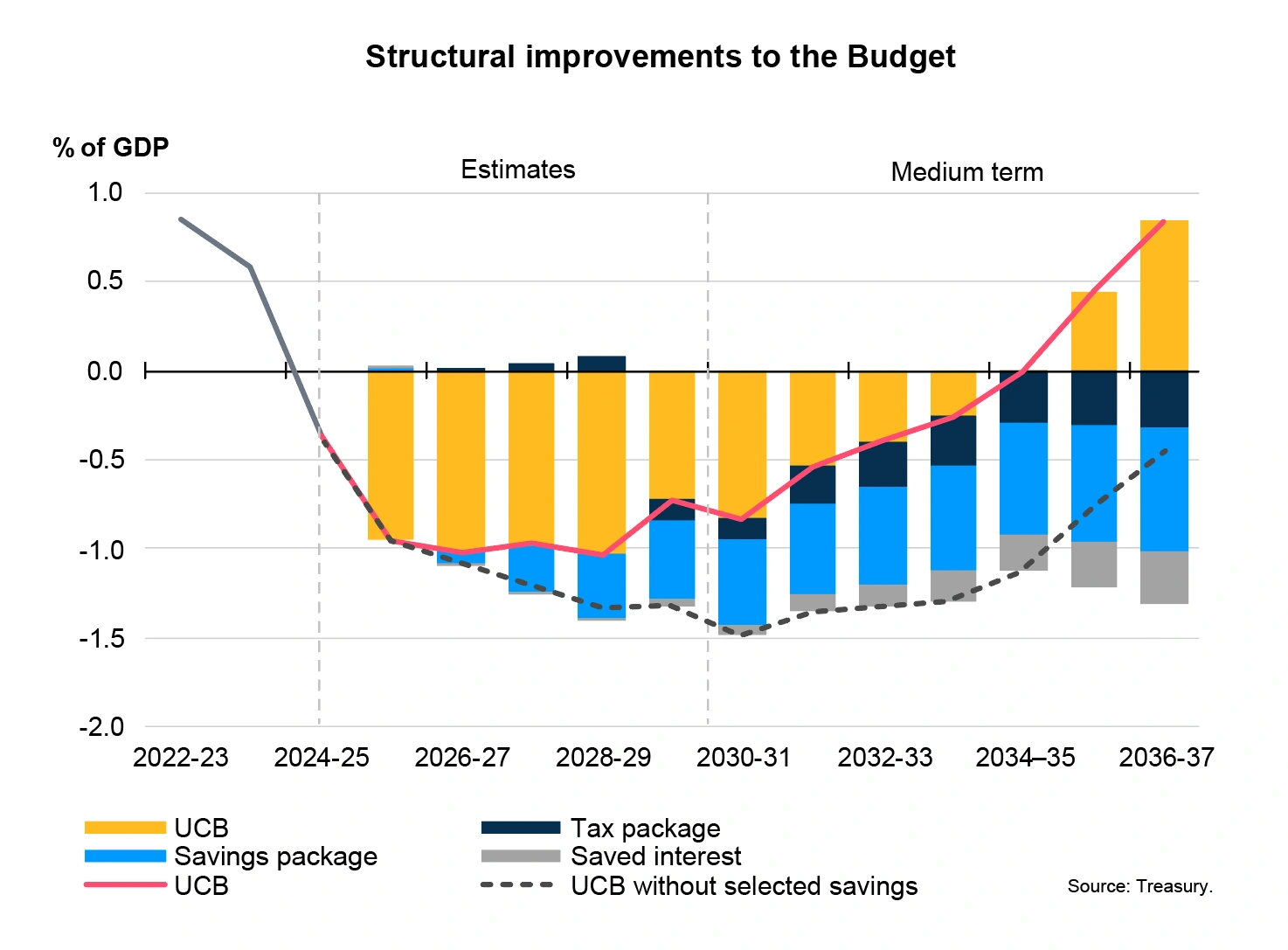
For a budget that had big billing as a transformative intervention and attempts to pick clear winners and losers, the outcomes for the nation’s finances are effectively neutral. The impact of this is continued growth in gross debt levels through the $1 trillion level in 2027. National borrowings have featured less in Australia’s political and economic debates in recent years as concerns around debt and deficit have waned since the pandemic, but the 2027 threshold might change that. “From zero to a trillion for a population of 30 million people in 20 years,” one young voter said. “And that includes the mining boom. Explain how you end up with that debt.”
This is the Albanese Government’s first big economic set piece since it was re-elected last year. A first budget of a term is conventionally big on deploying political capital and used to try shape the terrain for the election battles to come. Labor will be keenly aware that their victory was wide but very shallow. CT Group private polling in April found ALP primary support at 30%, down from 34.5% at the last election. There is a clear need to consolidate their voter base.
Hence the attempt to target younger aspirational voters, and the Labor-leaning cohort of renters. But from the voters we spoke to, this Budget doesn’t “click” for these groups. In parallel, there is a cohort of urban inner city voters who are educated and have some wealth. Their reactions to the tax changes are decidedly mixed.
Chalmers still has two more budgets to make headway. The critical task for the Coalition to present as a viable option is to demonstrate they grasp voters’ challenges and show a plan to address them. Without that, we can expect ongoing voter disillusionment and drift to independents and minor parties like One Nation.
Looking at some of the detail, the changes to negative gearing and Capital Gains Tax (CGT) will centre in the short-term political debate for two reasons. They represent the abandonment of an election promise, and they are the levers the government is pulling to try and support more young people to buy a home while seeking to redistribute capital away from older Australians.
Underwhelming ambitions
Setting aside the broken promise – a theme too well known to voters to be bothered about – these measures seek to tackle the widely acknowledged structural failures of the Australian housing market: price growth that puts ownership increasingly out of reach for young people, an outsize influence of investors distorting the market, and excess capital growth being concentrated in the hands of those who have owned homes for a long time. The political problem for the Government is that voters (a) find the policies very hard to understand and (b) notice they are slow-burn measures rather than immediate and effective fixes. The negative gearing changes grandfather existing arrangements and don’t take effect until next year.
This is the problem with more ambitious policy reform: it takes time. Time to sell, explain, deliver and enforce. Shifting from a simple 50% discount on capital gains to a system where there are moveable floors on tax rates paid while the original capital investment is indexed to inflation and discounted back over time isn’t easily pitched at a barbecue. On top of this, one of the challenges the Albanese Government will have is that it may not be ambitious enough. On its own numbers, the Budget will help 75,000 Australians buy a first home – a number that will be assessed as to whether it is really shifting the dial – while on the other side, the easing in house price growth will drag on the incentives to build new homes. The Budget papers admit that the policy will lead to 35,000 fewer homes being built than a scenario with no change.
Though a clear target voter group in this Budget is younger Australians, they were highly sceptical in their responses to us last night. “You have to have drastic decisions,” said one young participant, “which they’re not doing.”
Nobody in either the younger or older groups agreed the CGT and negative gearing changes would make housing more affordable. The connection between taxing investment gains and reducing house prices needs a chain of economic logic that neither group follows and the government hasn’t explained it – yet – with sufficient clarity. Younger voters are also specifically concerned that wealthy people will restructure their affairs, and those who cannot navigate the system will be affected. This reinforces a belief that the system is rigged against ordinary people.
Some younger voters do credit the government for attempting structural change, but the CGT measure is read as addressing a symptom rather than the root cause. The underlying problems are untouched: planning constraints, construction costs, and the pace of immigration relative to supply.
There were similar doubts in reaction to the Government’s planned NDIS cuts. This was the most galvanising negative, and the response divides three ways. Supporters of cuts are motivated by a belief the scheme is being rorted by providers and users who should not be on it. Those opposed know or work with genuine recipients who will be hurt. Those who are unsure focus on the practical challenges: who decides who comes off? How do you do that fairly? Where do people go when they lose support? What unites all three positions is that the government has not established the narrative that these are targeted savings against fraud and mismanagement. Voters want to hear the Government cracking down on criminals and scammers. They are not hearing it.
Why resilience matters
One clear reaction function in the Budget is a $14.8 billion resilience package. Much of this was previously announced or signalled through the Government’s efforts to respond to the fuel supply crisis. The Budget puts formal shape around the resilience commitments through a $3.2 billion fuel security reserve, which increases diesel and jet fuel reserves to 50 days. A Fuel and Fertiliser Security Facility delivers $7.5 billion in critical supplies of diesel, jet fuel and fertiliser.
Voters in our focus groups both raised resilience, unprompted, multiple times. Australia’s resilience is a topic we know to be highly salient amongst voters, and most potent prism through which they view the nation’s investment in defence capability, critical infrastructure and innovation. The Budget partially delivers on this, but there is an important gap between how the government has framed its response and what voters want to see. The government’s initiatives are responsive to their anxieties, but the initial framing is a response to the Iran crisis, rather than as a structural commitment to self-sufficiency. Voters want to hear Australia is building lasting independence. What they heard sounded like a band-aid for a specific emergency. The security frame connecting fuel reserves to hospital supply chains, grid stability, and national self-sufficiency was never made. If it had been, this measure likely would have landed very differently.
The data centre and AI infrastructure announcements are not landing because the underlying case has never been sufficiently made by the Government. The Budget’s detailed forecasts include a chunky 5% increase in non-mining business investment in the current financial year, followed by another 4% in FY27. Chalmers pointed to a healthy pipeline of data centre investments that will help deliver these outcomes. Given all the noise on data centres it is somewhat surprising to see non-mining investment only grew 0.2% in FY2025. With business capital expenditure being a critical requirement for solving Australia’s productivity challenges, it will be essential to see these ambitions realised.
Even here, there is a political challenge. Voters have not yet been told why data centre infrastructure matters to their lives or to Australia’s future. Without a clear explanation of how these investments support Australian industrial growth and protect Australian hospitals, power grids, and financial systems, the benefits – and the case for their active accommodation in economic policy – is unclear.
Turning to defence spending: voters see the new commitments as necessary, particularly given the changed relationship with the US, but it is being read as R&D rather than security. The framing is not connecting to the visceral anxieties Australians are feeling about the nation’s security. Voters want to feel protected. Announcements about research and development feel distant from that need.
The Budget papers provide some further detail on the $53 billion in new spending over ten years, under the 2026 National Defence Strategy and Integrated Investment Program released in April. The more revealing story is in the smaller measures. Funded entirely from within Defence’s existing resources (meaning the department has absorbed the cost internally), these include construction of the nuclear-powered submarine yard in South Australia, housing and workforce support for the submarine program, and development of Australia’s domestic defence industry. Together they reflect a Government steadily progressing the AUKUS architecture: building the physical infrastructure, securing regulatory approvals, standing up safeguards, and growing the workforce pipeline, while Defence quietly finds the money to pay for it.
One of the Government’s major initiatives after its re-election was the Treasurer’s Economic Roundtable, convened when lagging productivity growth was the pressing policy problem of the time. Other priorities have since eclipsed it, but there are some measures that the Government says are aimed at tackling this thorny and persistent problem for Australian business and our national economic prospects. Financial sector compliance costs will be reduced by $780 million a year including through increases to company reporting thresholds. One unexpected announcement is a vast investment of more than $650 million in expanding the use of the Government’s Digital ID across various services. Changes to the R&D incentive scheme are slated to unlock $400 million annually in additional research and development. For small business, the popular $20,000 instant asset write-off is being made permanent.
Where we stand
The lag in outcomes that voters intuitively sense is evident in how the Budget measures drop into the fiscal position over time. The new taxes and savings measures don’t build traction until FY2029, by which time we’ll have had an election which will come with promises that have price tags. This means that, for any political party seeking to deliver credible fiscal repair, there will need to be significant savings and/or taxes measures if there is to be meaningful progress in getting the nation’s finances back into some kind of balance.
As businesses around Australia know only too well right now as they struggling to manage input costs, forecasting for just 12 months ahead these days is a challenge. Take that as the backdrop for a projection or a notional promise that “we’ll turn the corner” in 2035.
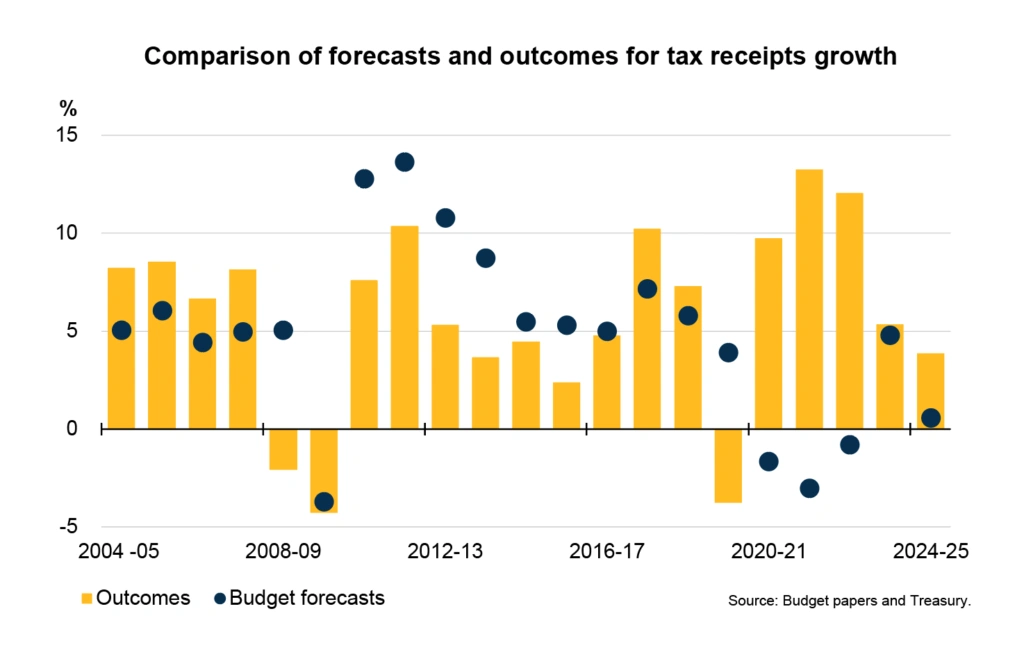
As a final note for anyone concerned about forecasting uncertainty, here’s a final excerpt from the Budget papers. It shows the gaps between the revenue forecasts and outcomes in the Budget going back two decades. As you can see, big overshoots on revenue are increasingly becoming the norm. A significant portion of this is due to the strong outcomes for Australia’s commodities in recent years, especially on iron ore which has hovered around US$90-100 while Treasury banked steady declines to US$60. It is one of the realities that means Australia can perhaps still reasonably lay claim to the title of the Lucky Country.
Stay ahead of global events.
Geopolitical instability moves markets, disrupts operations and reshapes the strategic landscape at board level. Register here to receive future briefings.